CRNNs: You don't always need a Transformer
computer-vision ocr deep-learning
CRNNs: You don’t always need a Transformer
With all the excitement around Vision-Language Models (VLMs) it’s easy to forget some of the deep learning classics that have quietly solved hard problems for years.
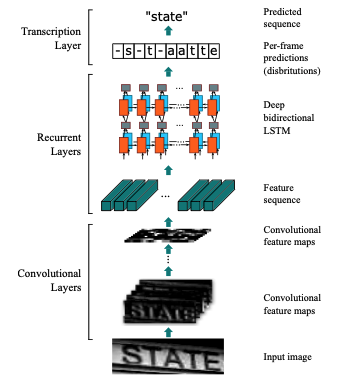
One of those is the Convolutional Recurrent Neural Network (CRNN). It’s not flashy, but it’s elegant, modular, and surprisingly effective for tasks like scene text recognition, handwriting transcription, or even speech. Please note the approach I’m refering to was proposed by Shi et al. in their CRNN paper (2016), where they combine CNNs with RNNs and CTC for scene text recognition.
💡 Why CRNNs Still Matter
The magic of CRNNs is in how they turn images into sequences — a bridge that still matters, even in the Transformers multi-modal era.
Let’s break it down:
CNN Component
The convolutional layers serve as a feature extractor. What’s great is their ability to:
- Extract hierarchical visual features
- Maintain spatial relationships
- Support interchangeable backbones (e.g., MobileNet if you want a faster model)
Want a lighter model? Swap in MobileNet or ShuffleNet and you’re good to go.
Mapping to Sequence
Once you have the feature maps, the model:
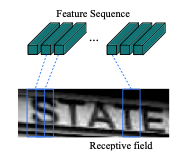
- Transforms them from a 2D map to a 1D sequence (usually left-to-right)
- Converts each column of the feature map into a feature vector
It’s such a simple idea — yet so effective for turning images into something sequence-friendly.
RNN Layer
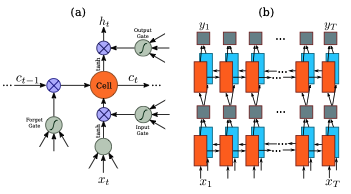
This is where things get interesting. Each feature vector (from left to right) becomes input to a Bidirectional RNN:
- Typically, BiLSTM or BiGRU
- Processes each timestep with context from both past and future
- Helps model spatial and semantic continuity in the image
Bidirectionality is crucial here — one direction alone just doesn’t cut it.
Transcription Layer (CTC Loss)
Probably the most elegant piece of the architecture — but also the most mysterious at first — is the CTC Loss.
- It maps many outputs (from RNN) to few predictions (e.g., characters or tokens)
- Avoids the need for pre-aligned labels
- Handles variable-length sequences naturally
I could write a whole post on Connectionist Temporal Classification (CTC) alone — and maybe I will! 😊
Pseudocode draft
# Pseudocode (PyTorch-like)
# CNN (Feature extractor)
features = cnn_backbone(image)  # shape: (B, C, H, W)
# Let's get into the RNN wolrd Perpendicularity
# Convert feature map to sequence (e.g., collapse H)
features = features.permute(0, 3, 1, 2)  # (B, W, C, H)
sequence = features.flatten(3)           # (B, W, C * H)
sequence = sequence.permute(1, 0, 2)     # (W, B, C*H) → time-first for RNN

# RNN layer
rnn_out, _ = BiLSTM(hidden_size)(sequence)  # (W, B, H)
🧠 Why I Still Love This Architecture CRNNs might not be the hottest topic right now, but their composability and efficiency make them hard to ignore. In many production pipelines — especially those with compute constraints — they remain incredibly useful.
👀 Up Next In a follow-up post, I’ll explore the CTC Loss, decoding tricks, and how it elegantly solves alignment for sequences.
If you’re into neural architectures that just work, hit follow or let me know your thoughts!
📚 References
- Shi, B., Bai, X., & Yao, C. (2016). An End-to-End Trainable Neural Network for Image-based Sequence Recognition and Its Application to Scene Text Recognition. arXiv preprint arXiv:1507.05717.