CTC Loss: What Makes It So Elegant (and Tricky!)
asr ocr deep-learning
CTC Loss: What Makes It So Elegant (and Tricky!)
In our last post on CRNNs, we peeled back the layers of their architecture — but left one powerful trick up the model’s sleeve: Connectionist Temporal Classification (CTC) Loss.”
It’s one of those ideas that seems magical at first — and the more I dig into it, the more I appreciate the elegance behind it. It is not something new, but rather an idea Schmidhuber and others published back in 2006 (paper link)
Here are a few takeaways I’ve gathered through hands-on experience and the occasional head-scratching moment. 😊
🎯 The Beauty of Soft Alignments
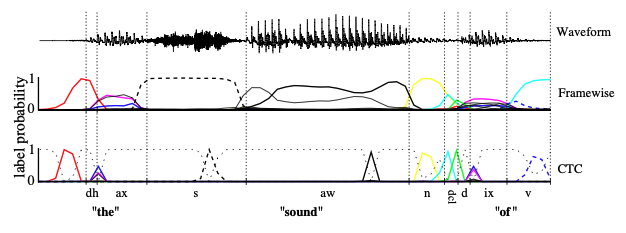
One of the best features of CTC is how it handles alignment without forcing a rigid frame-by-frame match.
Instead of requiring every output to match every label frame, CTC introduces a probability distribution over all possible alignments.
My favorite part? The special “blank” label — a humble yet powerful idea.
For example, if the word is "hello", CTC might model it internally as:
h _ e _ l l _ o
Where _ represents blanks. This allows the network to handle repeated labels and varying input lengths — essential in speech, handwriting, or scene text.
⚙️ Efficient by Design (Thanks to Dynamic Programming)
Here’s where things get wild: for a word like "hello" (5 characters) over a sequence of 10 timesteps, there are thousands of possible valid alignments.
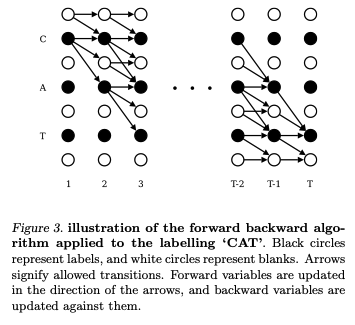
And yet, CTC manages to compute the total probability across all of them efficiently, thanks to dynamic programming.
Without this, we’d need to explicitly enumerate every alignment — which would be computationally explosive.
The trick lies in the forward-backward algorithm, a clever recurrence relation that avoids brute-force enumeration.
This makes CTC not only powerful but tractable for real-world use — even on longer sequences.
🧮 Differentiable and End-to-End
CTC is fully differentiable, so it can be dropped right into a standard deep learning pipeline.
For those of us with academic nostalgia: “differentiable” was always one of the most comforting words to hear during a paper reading. 😄
It enables end-to-end training without needing explicit alignments at any point — just the final label sequences.
⚠️ Initialization Woes: The Blank Label Trap
This one really got me.
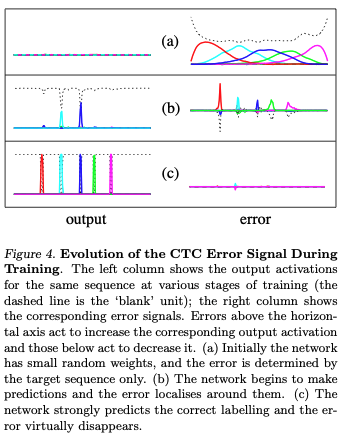
In early experiments, I struggled with blank label probability initialization. Turns out, getting this wrong can completely derail training:
- Too low: The model commits too early to alignments and gets stuck in poor local minima.
- Too high: Training becomes sluggish as the model overpredicts blanks and never learns to emit meaningful outputs.
After some painful debugging and reading, I found that initializing the blank probability to around 0.5–0.7 often strikes a good balance:
It gives the model enough flexibility to explore alignments early on, while still encouraging actual predictions.
TL;DR
CTC Loss is one of those underappreciated pieces of the deep learning toolbox. It:
- Models alignment without supervision
- Efficiently handles a huge number of sequence combinations
- Fits seamlessly into differentiable architectures
- Comes with a few sharp edges (like blank probability) that are worth watching
In a time when Transformers and Attention grab all the headlines, it’s nice to revisit building blocks like CTC that quietly power real-world systems — and still teach us new things.
Got questions or war stories of your own with CTC? Drop a comment or connect!
📚 Reference
- Graves, A., Fernández, S., Gomez, F., & Schmidhuber, J. (2006). Connectionist Temporal Classification: Labelling Unsegmented Sequence Data with Recurrent Neural Networks. Proceedings of the 23rd International Conference on Machine Learning.