
HELMET: A Fresh Look at Context-Length Evaluation in LLMs
llms long-context evaluation
HELMET: A Fresh Look at Context-Length Evaluation in LLMs
Following up on my previous posts, I’m still on a mission to better understand how LLMs perform (and fail) when dealing with different context lengths. That’s why I dived into this paper: HELMET: Holistic Evaluation of Language Models on Extended Text, by Howard Yen, Tianyu Gao, Minmin Hou, Ke Ding, Daniel Fleischer, Peter Izsak, Moshe Wasserblat, and Danqi Chen. You can take a look at the code on the following link as well.
The authors propose a very interesting benchmark system called HELMET.
🧪 What’s HELMET about?
HELMET sets up a benchmark that includes both classic and newer tasks. Think:
- Summarization
- Long document QA
- RAG
- Passage re-ranking
- Generation with citations (this one’s getting more attention lately)
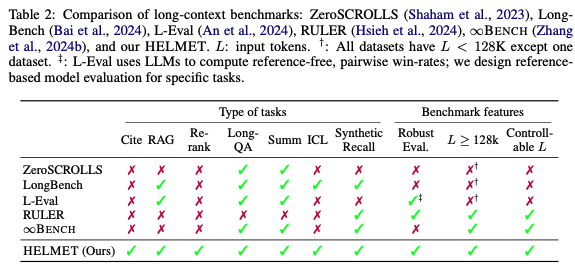
But what really caught my eye is their the smart way on which they use models-as-a-judge in the loop.
🤖 Metrics meet Judges
HELMET introduces a twist: augmenting traditional metrics with a model-in-the-loop judge. Instead of relying solely on fixed metrics like ROUGE — which, let’s be honest, often reward surface-level word overlap — they add a judge model to assess whether an answer actually makes sense.
This brings evaluations closer to how humans would reason. ROUGE might tell you that an answer looks similar to a reference, but it won’t tell you whether it’s actually right or useful. HELMET’s approach aims to bridge that gap.
Of course, there’s a tradeoff. Having a model act as judge introduces non-determinism — so by definition, this isn’t a pure metric anymore. That’s a flaw. But if the judge is a powerful model (e.g. GPT-4o) and the tasks aren’t too ambiguous, that non-determinism can be reduced. Still worth keeping in mind.
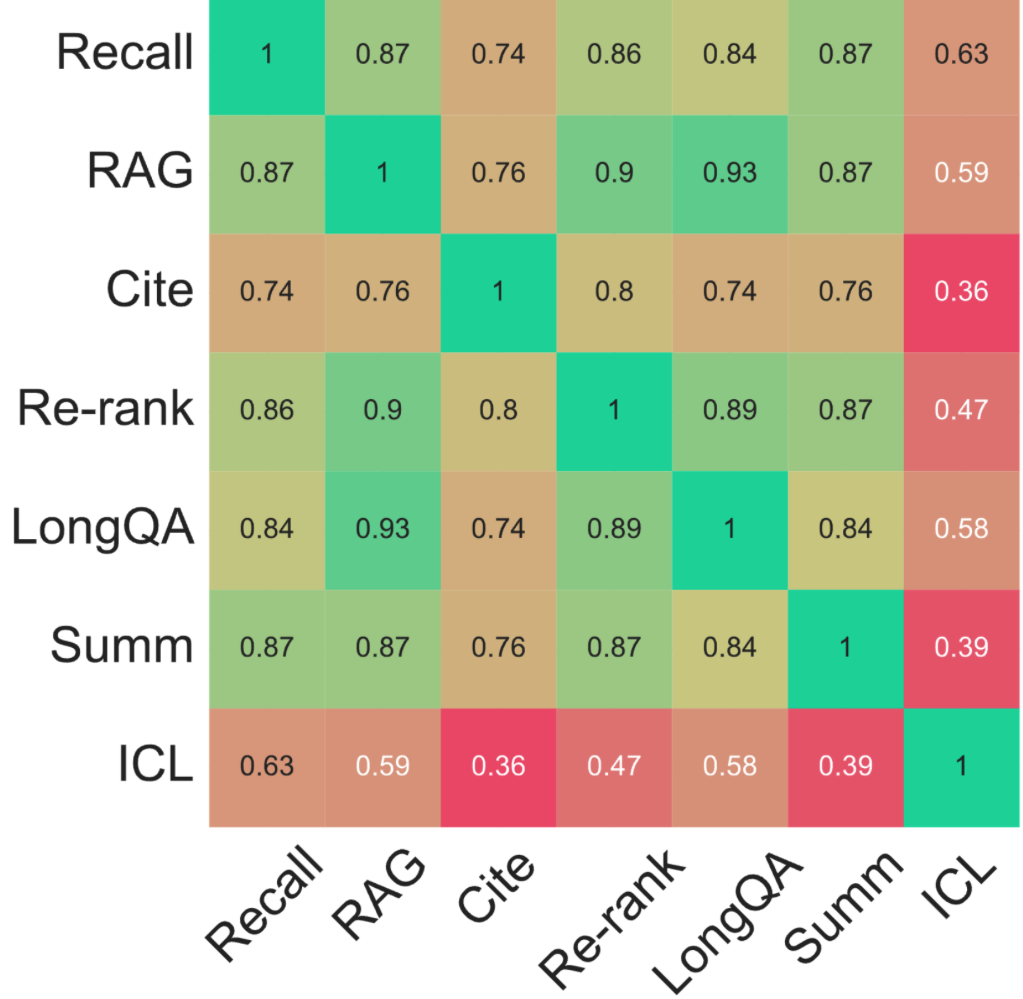
📉 What about results?
One fun example: Claude 3.5 Sonnet. It tends to include too much helpful preamble or explanation along with its answers. While that’s nice from a user experience perspective, it gets penalized in ROUGE-based evaluations like NarrativeQA F1. But! When evaluated using a model-as-a-judge, its performance looks much better.
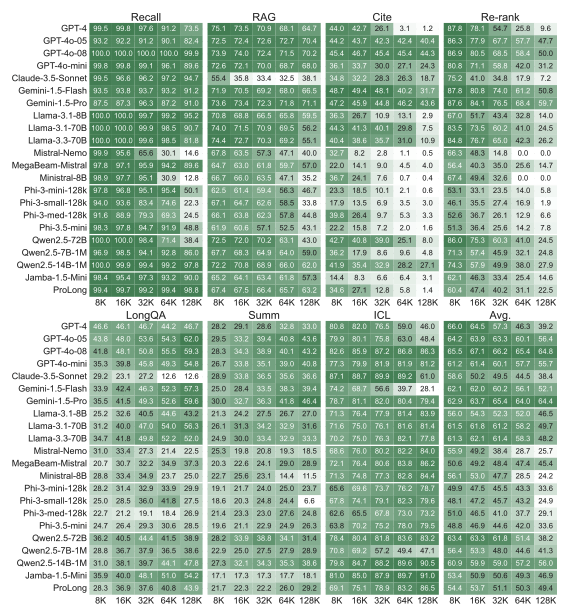
So, context matters — but so does how you evaluate it.
Figures 6 and 7 in the paper show clear trends of performance degradation as context length increases. But we’re not at the point where we can extract a clear “rule-of-thumb” for that.
That said, there is a visible difference between open-source and closed-source models. Open-source models tend to degrade faster with longer contexts. If I had to guess:
- Closed-source models become shaky beyond 32k–64k tokens.
- Open-source models start degrading around 8k–16k.
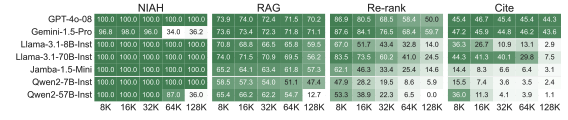
(Just a note — the paper was published back in October, so the included models were from before that.)
🧠 Final thoughts
HELMET isn’t perfect, but it’s a really welcome step toward more realistic evaluation frameworks. Especially in the era of LLMs handling massive contexts, we need smarter ways to measure how well they understand and reason over them.
And as always — context is everything, but how we measure understanding might matter even more.