
Titans: Neural Long-Term Memory for Enhanced Sequence Modeling
llms long-context architecture
There’s been a lot of noise lately about scaling, trillion-parameter models, and ultra-long context lengths. But while most attention went to the usual suspects, one paper from the past few months really stood out to me — and maybe didn’t get the buzz it deserved:
📄 Titans: Neural Long-Term Memory for Enhanced Sequence Modeling
🔗 Link to paper, Ali Behrouz, Peilin Zhong, and Vahab Mirrokni.
I think it’s a pretty interesting one. It basically brings an innovation to how models manage memory and context — something that’s getting more and more relevant these days.
🤯 Memory and Test Time
We already have LLMs that handle massive contexts (Gemini’s around 2M tokens, if I’m not wrong). That’s cool, but let’s be honest — longer doesn’t always mean better. Sometimes, longer contexts just mean less attention to detail.
Titans propose some kind of long-term memory (yeah, LSTMs, I love seeing you again!) that learns at test time.
Let me repeat that: at test time!
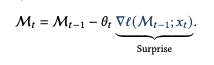
The model dynamically identifies parts of the context and flags them as relevant or not — so it knows what to remember. It does this through a clever metric the authors defined: “Surprise” — which basically measures how much a piece of context changes over time. The more it surprises the model, the more attention it gets.
🧠 Different Memory strategies
The authors propose three different approaches for using this memory module:
- MAC: Memory as context (add it to the input)
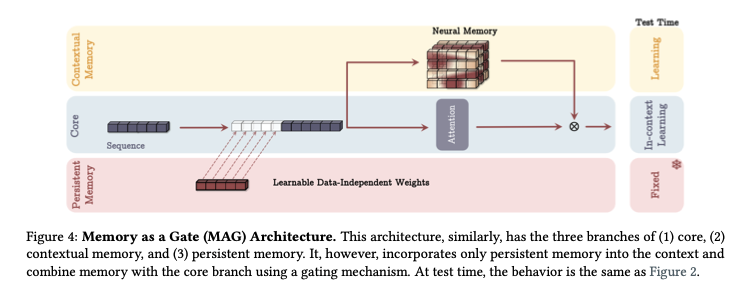
- MAG: Memory as a gate (like an LSTM-ish twist!)
- MAL: Memory as a layer (plug it in the architecture)
I personally liked MAG a lot — it gave me LSTM flashbacks in a good way. Instead of the usual gating, they use sliding window attention moving through time with memory outputs, which makes it much more adaptive. Feels like a neat evolution of the old tricks.
📊 The results? Titans-level.
The results are quite impressive, but my favorite part was the “needle in a haystack” test — you know, hiding info in a long context and seeing if the model can find it to answer questions.
Guess who was on top?
Of course, the Titans.
🚀 Why I’m excited
This paper brought back some memories (pun intended) of earlier architectures but added a modern spin that I found super refreshing. I’m really looking forward to experimenting with this one and seeing what kind of impact it can have in real-world tasks where remembering matters.
Maybe it’s time memory made a real comeback.